Serving Homeowners In Southwestern Virginia Since 2002
Call Now For A Professional Evaluation 540-774-2828
Interior Pressure Relief Drainage vs. Exterior Excavation in Blue Ridge Clay Soil
Waking up after a torrential Blue Ridge rainstorm to find standing water pooling across your basement floor is stressful enough. But when you look closely and notice damp wall bases or water seeping up through the slab seam, homeowner anxiety hits peak levels. In Southwestern Virginia, water intrusion isn’t just a minor nuisance—it is a direct threat to your home’s structural integrity, interior finishes, and property value.When evaluating waterproofing solutions, homeowners are typically faced with two main approaches: digging up the yard for exterior excavation or installing a sub-floor interior pressure relief system. Understanding how these systems perform in dense Appalachian soil is critical to making a lasting, cost-effective investment.
The Root Cause: Blue Ridge Clay Soil & Hydrostatic Pressure
Southwestern Virginia is famous for its dense, expansive red clay soil. While excellent for regional foliage, heavy clay presents a severe challenge for residential basements. Clay acts like a massive sponge—absorbing vast volumes of water during heavy rains and expanding against buried concrete block and poured concrete foundation walls.
As subterranean water accumulates around your foundation, it generates intense hydrostatic pressure. Water pushes downward and laterally, seeking any path of least resistance into your home. The most vulnerable entry points are mortar joints, wall cracks, and the cold joint—the perimeter seam where your basement concrete floor meets the foundation wall footing.
Option 1: Exterior Excavation (Digging Up the Perimeter)
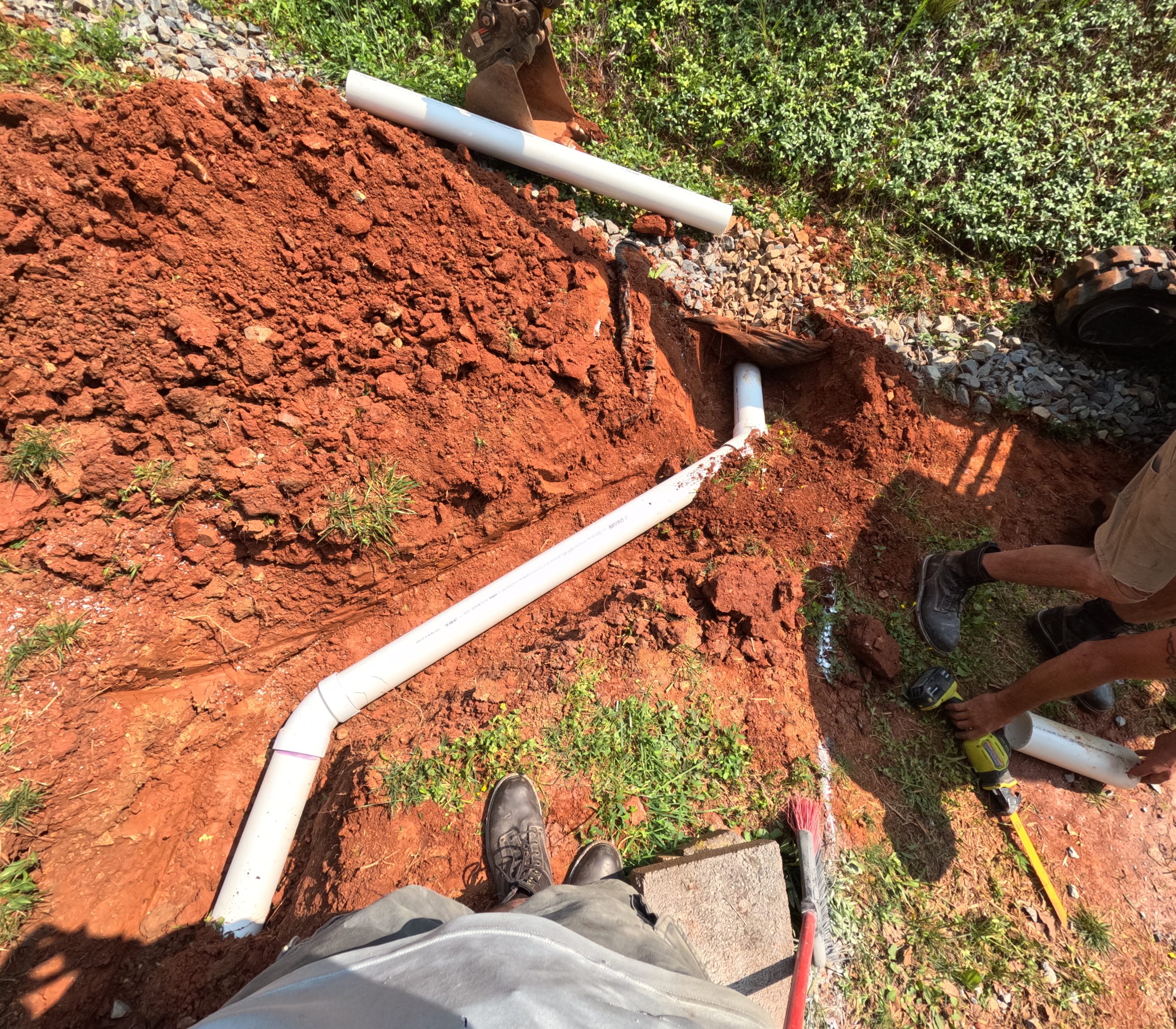
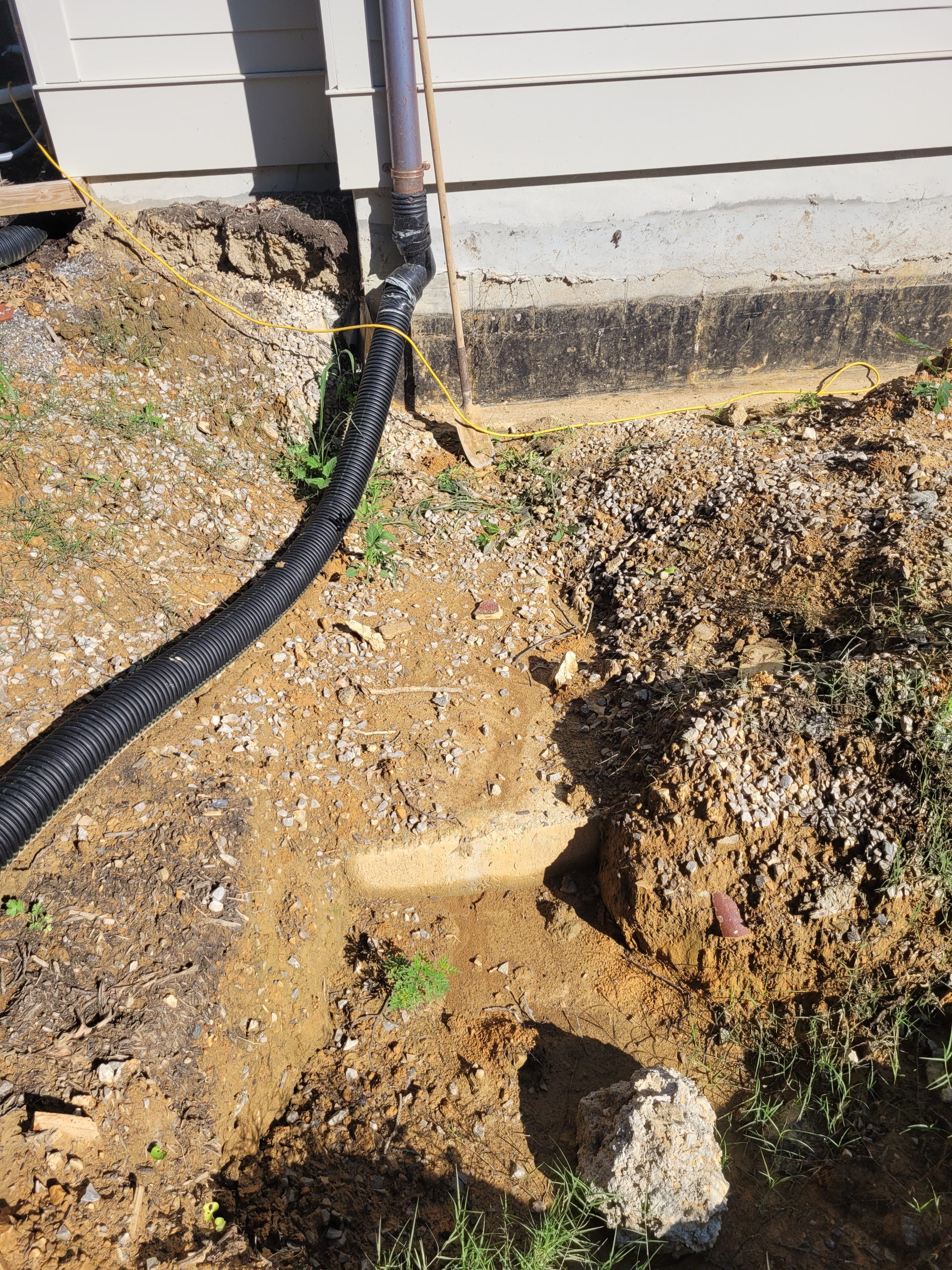
Exterior excavation involves using heavy machinery to dig a deep trench around the outside perimeter of your home down to the footing. Workers clean the exposed exterior wall, apply a waterproof membrane, place perforated drain tile, and backfill the trench with gravel and soil.
While conceptually straightforward, exterior excavation presents significant drawbacks in heavy clay environments:
Extreme Disruption & Cost: Excavation destroys surrounding landscaping, flowerbeds, concrete walkways, patios, and decks, driving labor and restoration costs sky-high.
The “Bathtub Effect”: Backfilling a deep trench in dense clay creates a porous pocket of loose soil surrounded by hard packed clay. Rainwater naturally channels into this loose trench, holding even more water against your foundation walls.
Fine Clay Silt Clogging: Over time, fine clay particles wash through filter fabric, clogging traditional flexible perforated pipe and causing exterior drainage systems to fail prematurely.
Rather than battling heavy outdoor clay soil, an interior pressure relief system intercepts water from beneath the basement floor right at the point of entry—relieving hydrostatic pressure before water can build up against your walls.
Here is how an engineered interior system functions:
Trench Creation: A narrow border of concrete floor slab is neatly removed along the interior perimeter walls to expose the top of the foundation footing.
Fast-Trak Drainage Installation: Instead of round corrugated pipe that easily traps sediment, an engineered Fast-Trak water collection system is bedded on gravel along the footing. Fast-Trak features a high-volume, smooth-channel design that resists clogging and directs water efficiently toward a heavy-duty sump pump basin.
Pre-Pour Water Verification: Before pouring new concrete, the system is flooded with water in real time to verify continuous flow, ensuring zero installation errors.
Slab Restoration: Smooth concrete is re-poured over the drainage channel level with your existing floor, leaving a clean, dry surface ready for finishing or storage.
Frequently Asked Questions
Why does interior pressure relief drainage outperform exterior waterproofing in clay?
Interior pressure relief directly neutralizes the root cause of basement leaks: sub-slab hydrostatic water pressure. By providing a dedicated, clog-resistant channel beneath the floor slab, water flows freely to the sump pump without requiring massive excavation that weakens exterior soil stability.
Will installing an interior drainage system ruin my finished basement?
Installation requires working along the perimeter floor edge. While bottom drywall cuts or stud framing modifications are required along exterior walls during installation, the central room space remains intact. Once fresh concrete is poured and cured, walls can be easily restored over a completely dry foundation floor.
What warranty comes with an interior Fast-Trak waterproofing system?
SURE-DRI backs its interior pressure relief installations with a transferable Full Lifetime of the Structure Warranty. Because Fast-Trak channels resist silt clogs better than perforated pipe, your home remains permanently protected against basement flooding.
Sure-Dri Basement Waterproofing was founded by Keith Martin in January 2002 and has been providing professional and reliable Basement Waterproofing and Foundation Repair services for Southwestern Virginia homeowners.
Keith was born and raised in Roanoke and has a lot of experience in the construction industry, he has been a General Contractor building residential and light commercial buildings since 1987. He has a MET engineering degree from Pellissippi State Tech at Knoxville and it is a Class A licensed contractor. He is also licensed in Radon Measurement and Mitigation.
Sure-Dri has a great crew with some employees who have been working in the company for over 20 years. Our employees are the backbone of the company prioritizing high ethics, professionalism, and exeptional customer service at heart.
To provide the best experiences, we use technologies like cookies to store and/or access device information. Consenting to these technologies will allow us to process data such as browsing behavior or unique IDs on this site. Not consenting or withdrawing consent, may adversely affect certain features and functions.
Functional Always active
The technical storage or access is strictly necessary for the legitimate purpose of enabling the use of a specific service explicitly requested by the subscriber or user, or for the sole purpose of carrying out the transmission of a communication over an electronic communications network.
Preferences
The technical storage or access is necessary for the legitimate purpose of storing preferences that are not requested by the subscriber or user.
Statistics
The technical storage or access that is used exclusively for statistical purposes.The technical storage or access that is used exclusively for anonymous statistical purposes. Without a subpoena, voluntary compliance on the part of your Internet Service Provider, or additional records from a third party, information stored or retrieved for this purpose alone cannot usually be used to identify you.
Marketing
The technical storage or access is required to create user profiles to send advertising, or to track the user on a website or across several websites for similar marketing purposes.