Serving Homeowners In Southwestern Virginia Since 2002
Call Now For A Professional Evaluation 540-774-2828
Bowing Block Walls & Leaking Basements: Why Exterior Excavation Fails in Blue Ridge Clay
Waking up after a torrential Blue Ridge rainstorm to find standing water pooling across your basement floor is stressful enough. But when you look closely at your foundation walls and notice horizontal cracking or an inward bow running along the cinder block mortar joints, that stress turns into genuine anxiety. In Southwestern Virginia, water intrusion and structural wall failure almost always go hand in hand.When searching for a solution, many homeowners are told that the only way to fix a wet, bowing basement is full exterior excavation—digging a deep trench around the outside of the home to install new perimeter pipe and membrane waterproofing. However, in our region’s distinct geological environment, traditional exterior excavation is often incredibly destructive, prohibitively expensive, and prone to premature failure. Understanding how local soil mechanics interact with concrete block foundations reveals why interior pressure relief systems offer a vastly superior, permanent fix.
The Hidden Force: Hydrostatic Pressure in Heavy Blue Ridge Red Clay
To understand why foundation walls fail, you must first look at the unique characteristics of Southwestern Virginia soil. Properties in Roanoke, Botetourt, Bedford, and surrounding counties rest on heavy red clay soil that acts like a massive subterranean sponge.
During intense mountain downpours, this expansive clay absorbs thousands of gallons of water, swelling dramatically in volume. When saturated soil presses against hollow concrete cinder block walls, it exerts intense hydrostatic pressure. Because hollow block walls are held together by mortar joints, they are particularly vulnerable to lateral ground force. Over time, this pressure causes the middle of the wall to bow inward, creating telltale horizontal cracks and forcing water through the mortar joints and floor-cove seams.
3 Reasons Exterior Excavation Fails in Southwestern Virginia
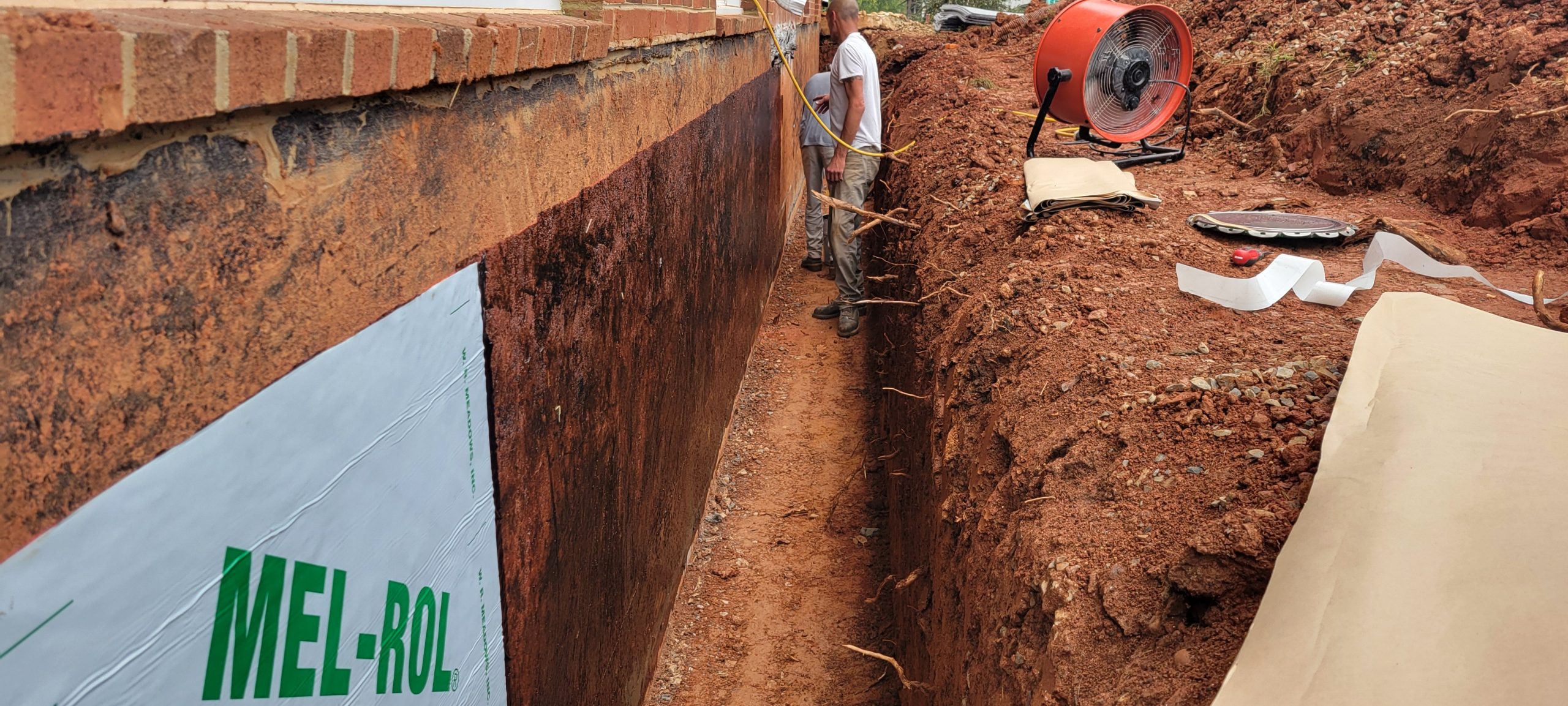
On paper, waterproofing a home from the outside sounds logical: keep the water from touching the wall in the first place. In practice across the Blue Ridge region, exterior excavation presents severe structural and financial drawbacks:
Severe Property Disruption: Exterior excavation requires heavy machinery to dig a 6-to-8-foot deep trench around your home’s perimeter. This process destroys expensive landscaping, concrete driveways, stone patios, porches, and wooden decks, adding thousands of dollars in restoration costs.
Red Clay Clogging & Silt Infiltration: Standard perforated corrugated pipe placed in exterior trenches quickly becomes choked by heavy red clay silt and organic debris washing down from surface soil. Within a few years, the pipe clogs, hydrostatic pressure builds up again, and water leaks resume.
Structural Risk to Settled Backfill: Once a trench is refilled with loose earth, that backfilled soil settles unpredictably over several years. This loose soil holds even more water directly against your foundation wall than undisturbed native soil, exacerbating lateral pressure.
The Fast-Trak Interior Pressure Relief Solution
Rather than fighting a losing battle against surface clay, an engineered interior drainage system manages groundwater where it naturally collects—below the concrete basement floor at the base of the footing.
By installing our exclusive Fast-Trak interior drainage system, we create an open sub-floor channel that relieves hydrostatic pressure before water can force its way through wall seams. Unlike flexible perforated pipe, Fast-Trak’s smooth rigid design collects more water, moves it faster, and completely resists clogging from soil particles. Best of all, our installation crews perform thorough water testing on every system before repouring concrete, guaranteeing it functions flawlessly.
Combining Drainage with Carbon Fiber Wall Stabilization
While interior drainage permanently eliminates hydrostatic water pressure, bowing block walls still require structural reinforcement to restore stability. By bonding aerospace-grade carbon fiber straps directly to the interior block face, we lock the wall in place permanently. Carbon fiber straps tie the concrete footing to the top rim joist with zero floor space loss and zero exterior excavation.
Why Engineering Oversight Matters
Fixing a bowing, leaking foundation requires precise structural load calculations, not high-pressure sales tactics. At SURE-DRI Basement Waterproofing, we are a licensed Class A Contractor with a Licensed Structural Engineer on staff. We evaluate your home’s exact soil conditions and structural deflection to deliver custom, lasting solutions backed by a transferable Lifetime of the Structure Warranty.
Is Interior or Exterior Basement Waterproofing Better for Southwestern Virginia Homes?
For many homes with bowing block walls and basement leaks in Southwestern Virginia, an interior pressure relief system can be more practical than full exterior excavation because it manages groundwater at the footing without requiring extensive digging around the home. If hydrostatic pressure has already caused structural wall movement, drainage may need to be combined with carbon fiber reinforcement or another engineered foundation repair solution.
The correct approach depends on the source of the water, foundation construction, soil conditions, and the amount of wall movement, which is why an on-site evaluation is important before choosing a waterproofing method.
Frequently Asked Questions
Why does water enter where the basement wall meets the concrete floor?
This seam is called the cove joint. Because the floor slab and foundation walls are poured separately, this seam remains an open expansion gap. Rising groundwater creates hydrostatic pressure beneath the slab, pushing water directly up through this cove joint.
Will interior waterproofing stop my basement walls from bowing inward?
Interior drainage relieves the hydrostatic water pressure pushing against the wall, stopping future movement from worsening. However, if the wall has already bowed inward by more than two inches, carbon fiber straps or structural tiebacks must be installed alongside the drainage system to guarantee structural integrity.
How long does an interior basement waterproofing installation take?
Because interior pressure relief systems avoid massive exterior trenching, most residential installations—including Fast-Trak drainage, sump pump integration, and floor repouring—are fully completed and water-tested in just 2 to 3 days.
Protect Your Basement and Foundation in Southwestern Virginia
Bowing block walls, horizontal foundation cracks, and basement water intrusion are often connected problems—especially in Southwestern Virginia, where heavy clay soil and periods of intense rainfall can place significant pressure around a home’s foundation. Addressing only the visible leak may not solve the underlying drainage or structural issue.
At SURE-DRI Basement Waterproofing, we evaluate both sides of the problem. Depending on your home’s conditions, the right solution may include an interior basement drainage system, sump pump integration, carbon fiber wall stabilization, or a customized foundation repair plan designed to control water and stabilize the structure.
Based in Roanoke, Virginia, SURE-DRI serves homeowners throughout the Roanoke Valley and surrounding Southwestern Virginia communities, including Roanoke, Salem, Cave Spring, Daleville, Wirtz, Newport, Radford, Bedford, Rocky Mount, and surrounding areas.
If you’ve noticed water entering your basement, horizontal cracks in concrete block walls, inward bowing, or water collecting along the wall-floor joint, don’t wait for the next heavy rain to see whether the problem gets worse.
Sure-Dri Basement Waterproofing was founded by Keith Martin in January 2002 and has been providing professional and reliable Basement Waterproofing and Foundation Repair services for Southwestern Virginia homeowners.
Keith was born and raised in Roanoke and has a lot of experience in the construction industry, he has been a General Contractor building residential and light commercial buildings since 1987. He has a MET engineering degree from Pellissippi State Tech at Knoxville and it is a Class A licensed contractor. He is also licensed in Radon Measurement and Mitigation.
Sure-Dri has a great crew with some employees who have been working in the company for over 20 years. Our employees are the backbone of the company prioritizing high ethics, professionalism, and exeptional customer service at heart.
To provide the best experiences, we use technologies like cookies to store and/or access device information. Consenting to these technologies will allow us to process data such as browsing behavior or unique IDs on this site. Not consenting or withdrawing consent, may adversely affect certain features and functions.
Functional Always active
The technical storage or access is strictly necessary for the legitimate purpose of enabling the use of a specific service explicitly requested by the subscriber or user, or for the sole purpose of carrying out the transmission of a communication over an electronic communications network.
Preferences
The technical storage or access is necessary for the legitimate purpose of storing preferences that are not requested by the subscriber or user.
Statistics
The technical storage or access that is used exclusively for statistical purposes.The technical storage or access that is used exclusively for anonymous statistical purposes. Without a subpoena, voluntary compliance on the part of your Internet Service Provider, or additional records from a third party, information stored or retrieved for this purpose alone cannot usually be used to identify you.
Marketing
The technical storage or access is required to create user profiles to send advertising, or to track the user on a website or across several websites for similar marketing purposes.